Flash USDT Creation Method Working Guide
· based on the channel Rca FastPrint
Flash USDT refers to a method of creating USDT-like tokens instantly using blockchain development tools and smart contracts. This guide explains how to create Flash USDT by leveraging the Ethereum network, ChainIDE development environment, and MetaMask wallet interface. The method focuses on understanding the token structure, setting up the environment, and interacting with smart contracts safely.
Understanding Flash USDT
Flash USDT is essentially a token created on Ethereum following the ERC20 standard, mimicking the characteristics of USDT (Tether). The "flash" concept highlights rapid token creation and deployment, useful for development, testing, or educational purposes rather than actual fund transfer.
The process involves writing and deploying smart contracts that define the token’s parameters like name, symbol, total supply, and decimals. These contracts comply with Ethereum's ERC20 token standard, ensuring compatibility with wallets and exchanges that support ERC20 tokens.
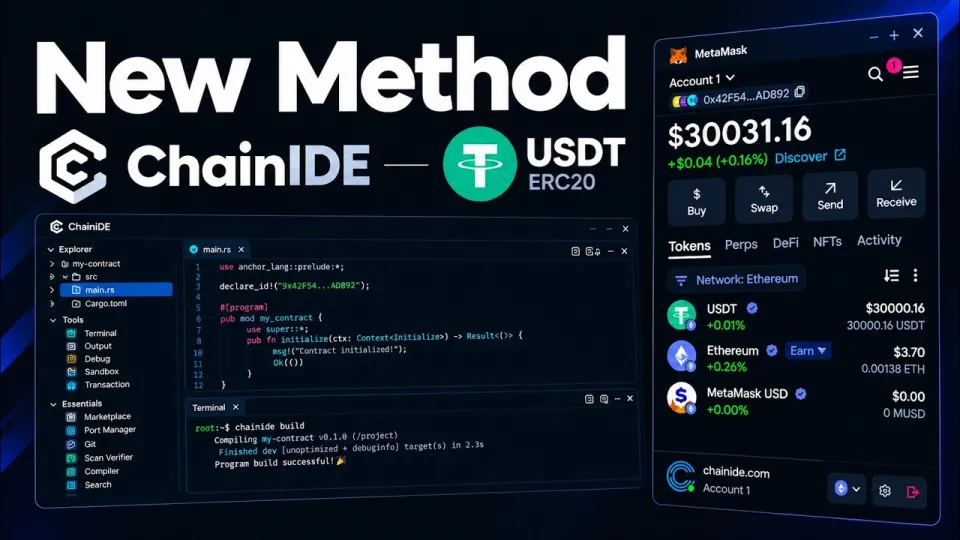
Video: How to Make Flash USDT | Working Method 2026
Setting up ChainIDE for Flash USDT Creation
ChainIDE is a cloud-based integrated development environment tailored for blockchain and smart contract development. To start creating Flash USDT:
- Visit the official ChainIDE platform and create an account if necessary.
- Open a new Solidity project and import or write the ERC20 token contract code.
- Use the provided ChainIDE script available at Flash USDT ChainIDE Script to ensure correct contract structure.
- Compile the contract and resolve any errors.
ChainIDE provides an interface that simulates blockchain behavior, allowing developers to test contracts before deployment.
Connecting MetaMask and Deploying the Token
MetaMask is a browser extension wallet that interacts with Ethereum and other compatible blockchains. For Flash USDT creation:
- Install MetaMask and create or import an Ethereum wallet.
- Connect MetaMask to a testnet (such as Goerli or Sepolia) to avoid using real Ether.
- In ChainIDE, configure deployment settings to use MetaMask’s connected wallet.
- Deploy the compiled ERC20 contract to the selected test network.
After deployment, the new Flash USDT token appears in your MetaMask wallet, allowing you to send, receive, and interact with it as with any ERC20 token.
Smart Contract Development Workflow
The workflow for developing Flash USDT includes:
- Writing Solidity code for the token contract based on ERC20 standards.
- Using ChainIDE to edit, compile, and troubleshoot the code.
- Testing contract functions such as minting, transferring, and balance checking.
- Deploying the contract to the Ethereum testnet via MetaMask.
- Verifying the contract on blockchain explorers to confirm authenticity.
This approach ensures the contract behaves as intended and reduces risks before any real interaction.
Common Mistakes and Security Checks
When creating Flash USDT tokens, avoid the following mistakes:
- Deploying contracts on the mainnet without thorough testing.
- Sending real funds to unknown or unverified contracts.
- Ignoring contract source code verification and audit.
- Connecting wallets to suspicious sites or scripts.
Always double-check the contract address, review the source code independently, and test on testnets first. These precautions protect your assets and maintain security.
Educational and Testing Purposes Only
The Flash USDT method is primarily educational. It demonstrates how tokens can be created quickly using smart contracts and blockchain developer tools. This method is not intended to produce real USDT or replace official stablecoins. Users should never send real money to untrusted contracts or services.
Useful Links
- Official Flash USDT ChainIDE script and guide: https://sites.google.com/view/defiflashusdt
Итог
The Flash USDT creation method provides a practical introduction to ERC20 token development using ChainIDE and MetaMask. It covers the full workflow from coding to deployment and wallet interaction, emphasizing safety and testing. For a detailed walkthrough and visual demonstration, refer to the Rca FastPrint channel, which offers valuable insights on this method. Use the official Flash USDT script and guide to get started responsibly and educate yourself about token creation on Ethereum.
Key takeaways
- Flash USDT is created using smart contract development on Ethereum.
- ChainIDE and MetaMask are essential tools for the Flash USDT workflow.
- The method involves ERC20 token standards and smart contract interaction.
- Testing and verification are crucial before using real funds.
- The process is educational and intended for development and testing only.
Source: How to Make Flash USDT | Working Method 2026 · Markdown version
Questions & answers
What is Flash USDT and how does it differ from regular USDT?
Flash USDT is a token created using a quick smart contract deployment method on Ethereum for educational and testing purposes. It is not an official stablecoin like regular USDT issued by Tether and does not hold real-world value.
Which tools are necessary to create Flash USDT?
The primary tools are ChainIDE, a blockchain development environment for writing and testing smart contracts, and MetaMask, a cryptocurrency wallet to deploy and interact with the token on Ethereum testnets.
Is it safe to use the Flash USDT method with real funds?
No, the Flash USDT method is intended for development and testing only. Sending real funds to unverified or unknown contracts can result in loss. Always test on Ethereum testnets and verify all contract details before any real transactions.
Can I use Flash USDT tokens on Binance or other exchanges?
Flash USDT tokens created through this method are custom tokens on test networks and not recognized by major exchanges like Binance. They are meant for educational purposes and cannot be traded like official USDT tokens.